At 9 a.m. on Saturday, November 18, B.Wine departed from the gray city of Milan, heading eastward towards the enchanting hills of Valpolicella in the province of Verona. In the minds of the fifty B.Winers, the flavors of a land with a millennial oenological history were already being anticipated. The winemaking tradition in this area can be traced back to the presence of the Italic people of Arusnats from the 5th century B.C. onward, continuing under Roman rule. In that era, wines from this region found mention in Virgil’s Georgics and Catullus’ cantos.
As we approached Lake Garda, marking the border between Lombardy and Veneto, the Valpolicella hills began to appear in the distance. We made a first stop in Lazise, a charming town by the lake known for being the first recognized Italian municipality and the most historic city to visit on the lake. After a typical Veronese lunch, we finally moved inland to reach the winery that was the subject of our visit: MASI.
MASI is more than just one of the many wineries in this area; it is a real institution in Valpolicella. Its history is rooted in this territory since 1776, the year of the first grape harvest operated by the Boscaini family (whose seventh generation still leads the winery) within the so-called “Vajo dei Masi” vineyard. We had the pleasure of visiting their “Tenuta Canova,” located abutting the Valpolicella Classica area and still lapped by the lake breeze, creating a perfect environment for wine cultivation. Here, they mainly produce one of their most iconic wines, the Rosso Verona IGT “Campofiorin.”
Upon our arrival, the welcome was fantastic. After an introduction and a look at the vineyards, they led us inside the winery to explore the winemaking process. First, we had the opportunity to observe the different grape varieties that most characterize the area: Corvina, Rondinella, and Molinara, accompanied by an extremely peculiar fourth variety named Oseleta, rediscovered only in recent years. The first one is the most identifying, giving body and structure to the wine with a noticeable tannic component, while the second one distinguishes itself mainly for the herbaceous note and the deep red color; the third one is generally used in a smaller dose. We had the opportunity to observe the locations where the different stages of the vinification process take place, from alcoholic fermentation to malolactic fermentation, to the final barrel aging.
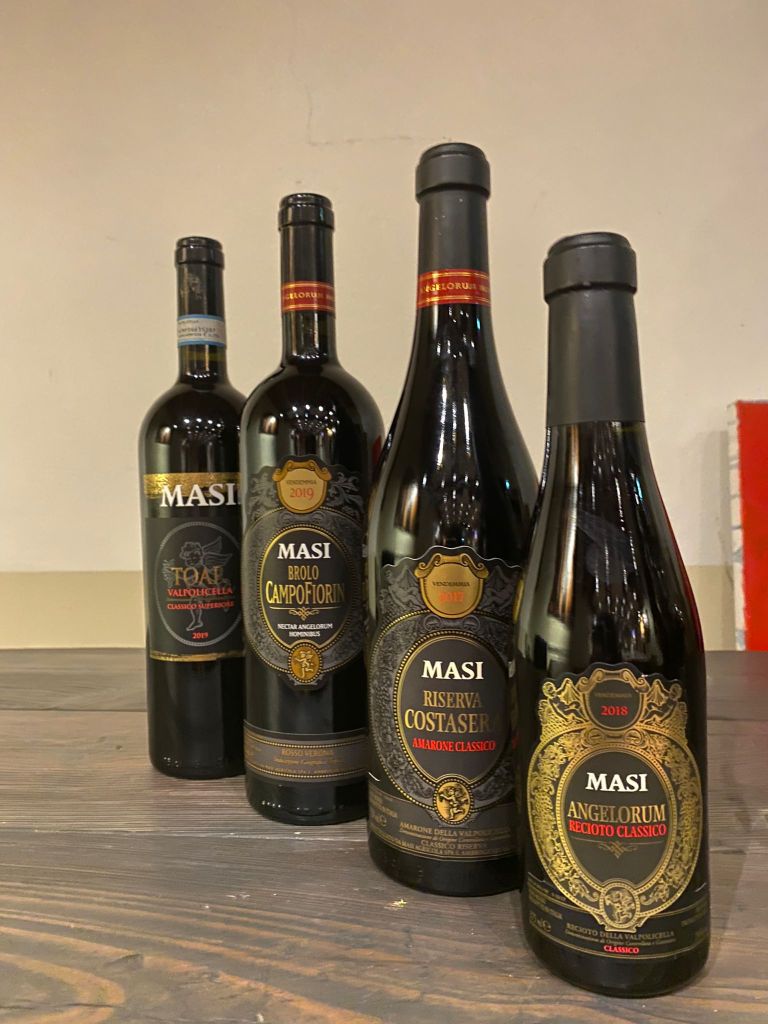
After concluding the tour, it was time to taste four of the most iconic MASI bottles: four red wines able to express the different shades of Valpolicella and Verona area in general, obtained from various compositions of the same autochthonous grape varieties within different production processes and years.
We started with a Valpolicella Classico Superiore DOC “Toar” (2019), a wine able to express, with its genuine nature made of fruity and tasty notes, all the intense character of Valpolicella.
We continued with a must within MASI production: the Rosso Verona IGT “Brolo Campofiorin” 2019. The peculiarities of this wine refer to the particular winemaking process inspired by the Amarone one, with a second fermentation together with dried grapes: this gives the wine a more complex structure and roundness. Hints of cherry, berries, and baked fruits dominate the scene, together with more structured notes of spices and vanilla. The presence of Oseleta, a more particular and rare grape variety, together with Corvina and Rondinella, gives even more complexity to the wine.
We then moved to the big star of the evening: the Amarone della Valpolicella Classico DOCG Riserva “Costasera” 2017. The high-soundness of the name was also found within the tasting of it: complexity, structure, and power are the result of the peculiar production process, characterized by the over-ripening of grapes on racks and at least three years of aging. The grape varieties used are all the four aforementioned: Corvina, Rondinella, Molinara, and Oseleta.
To close the tasting, so far accompanied by some Venetian “cicchetti,” we moved to the sweetness of the Recioto della Valpolicella Classico DOCG “Angelorum” 2018, which was served to us along with dark chocolate. This dessert wine is the one that is still most connected to the Valpolicella’s tradition, related to the drying of the usual aforementioned grapes.
The tasting thus came to an end, and the B.Winers group was ready to come back home, but not without a gift personally offered by MASI to each of us: a bottle of their classic “Campofiorin.”
Riccardo Mirarchi
Check these links!!
- https://www.masi.it/it/vini/toar-valpolicella-classico-superiore-superiore-doc-vino-rosso
- https://www.masi.it/it/vini/brolo-campofiorin-vino-rosso-verona-igt
- https://www.masi.it/it/vini/riserva-costasera-amarone-valpolicella-classico-docg-riserva
- https://www.masi.it/it/vini/angelorum-recioto-valpolicella-classico-docg




 B.Wine